Phone:
(844) 462-4730
Business Hours
Mon-Fri: 9AM - 6PM
Address
97 Newkirk Street, 3rd Floor
Jersey City, NJ 07306

Phone:
(844) 462-4730
Business Hours
Mon-Fri: 9AM - 6PM
Address
97 Newkirk Street, 3rd Floor
Jersey City, NJ 07306

Payroll doesn’t wait. When revenue timing falls behind payroll dates, payroll business loans can help small companies cover employee wages, payroll taxes, and near-term operating pressure without interrupting business operations.
Used strategically, payroll funding for small business is not about covering chronic losses. It is a short-term working capital solution designed to support cash flow management during timing gaps caused by slow accounts receivable, seasonal swings, or temporary expansion costs.
Depending on the situation, business payroll loans may come in the form of a short term loan, revenue based financing, or a business line of credit for payroll.
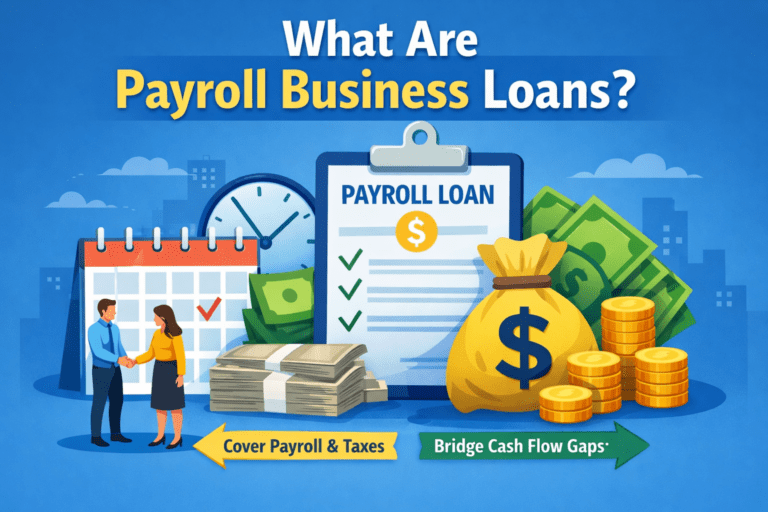
Payroll business loans are business funding solutions used specifically to cover employee wages,payroll taxes, benefits, and related payroll obligations when incoming cash has not yet caught up with outgoing expenses.
They fall under broader working capital financing, but their purpose is more specific: helping business owners bridge short-term payroll pressure without disrupting staff confidence or day-to-day operations.
Many businesses explore payroll business loans not because the company is failing, but because payroll deadlines often arrive before receivables clear or seasonal revenue normalizes.
One of the most common reasons businesses seek payroll funding for small business needs is delayed customer payment cycles. If clients pay on Net-30 or Net-60 terms, payroll can come due before cash reaches the business bank account.
That timing mismatch is exactly where payroll business loans or invoice-based solutions can help stabilize short-term working capital.
Retail, construction, and hospitality businesses often experience uneven monthly income.
Hiring new employees increases payroll before new revenue stabilizes.
Equipment breakdowns or supplier disruptions can compress operating capital quickly.
💡 Pro Tip: Before applying for payroll financing, review guidance on managing working capital from the U.S. Small Business Administration. Sometimes improving receivable collection reduces your need for outside capital.
There is no single product labeled for every payroll need. Instead, payroll business loans are usually structured through several funding vehicles depending on how often the cash flow gap happens, how quickly capital is needed, and how the business generates revenue.
A business line of credit for payroll can be one of the most practical options for companies that face temporary payroll pressure more than once. Instead of taking a new lump-sum loan every time wages come due before receivables clear, the business can draw only the amount needed and repay based on the line terms.
For companies with recurring payroll timing issues, this structure may offer better flexibility than stacking multiple short term loans.
Programs like the SBA 7(a) Loan Program allow payroll usage but often involve longer underwriting timelines.
💡 Pro Tip: If payroll compression happens more than twice a year, a business line of credit typically offers better flexibility than stacking multiple short term business loans.
Most business payroll loans are underwritten using a practical view of business performance, including monthly revenue, bank statement consistency, time in business, existing debt exposure, and overall cash flow management.
Many alternative lending platforms focus heavily on cash flow trends rather than just business credit score.
Funding timelines can range from 24–72 hours once documentation is submitted.
Typical documents include:
3–6 months of bank statements
Basic company information
Government-issued ID
Voided check
Payroll business loans make the most sense when the company is dealing with a temporary timing issue rather than a permanent profit problem. Businesses often use payroll funding for small business needs when accounts receivable are delayed, seasonal demand causes uneven monthly revenue, or growth temporarily increases labor costs before new income arrives.
In those situations, the right structure can protect employee retention, preserve operational continuity, and give management time to stabilize working capital without missing payroll.
Payroll financing is short-term capital. That speed comes with pricing considerations.
Costs may be structured as:
Simple interest
Fixed fee
Factor rate
Revenue percentage
If offered a factor rate, convert it into an effective APR for comparison.
💡 Pro Tip: Before accepting any payroll loan, calculate total repayment cost and daily cash flow impact. High daily remittance structures can strain thin margins if not modeled correctly.
Calculate your loan amount in just a few clicks.
Estimated Approval Range
$0 – $0
* Estimate Disclaimer: The figures are approximations. Loans are subject to lender approval. Depending on the state where your business is located and other attributes of your business and the loan, your business loan may be issued by a member of the AMP Advance family of companies. Your loan agreement will identify the lender prior to your signing.
| Option | Speed | Flexibility | Risk Level |
|---|---|---|---|
| Payroll Loans | Fast | Medium | Moderate |
| Invoice Factoring | Moderate | Medium | Low to Moderate |
| Credit Cards | Immediate | High | High (revolving interest) |
| Bank Loans | Slow | Medium | Low |
There are two types of payroll loan users:
Borrow precise amounts
Align repayment with receivables
Use financing temporarily
Borrow repeatedly
Stack funding solutions
Ignore operational inefficiencies
Only one model builds long-term business growth.
💡 Pro Tip: If payroll loans are recurring monthly, conduct a pricing and margin audit. Payroll financing should bridge timing gaps—not subsidize structural losses.
Payroll reliability is one of the clearest signals of business stability to your team. When payroll is delayed, the damage is not just financial. It can affect morale, trust, and long-term employee retention.
That is why payroll funding for small business owners is often about more than cash flow. It is also about protecting workforce continuity and maintaining confidence inside the company.
Business payroll loans may help:
Payroll financing is powerful—but not without risk.
Common mistakes include:
Borrowing more than needed
Ignoring repayment timing
Not comparing multiple funding solutions
Using payroll loans to cover ongoing losses
If revenue is declining structurally, financing will not solve the underlying issue.
💡 Pro Tip: Run a 90-day cash flow projection before applying. If projected revenue cannot comfortably cover repayment plus operating capital, reassess before taking on debt.
Payroll business loans are funding solutions used to cover employee wages, payroll taxes, benefits, and related payroll obligations when short-term cash flow gaps arise.
Payroll funding for small business refers to short-term working capital used to keep payroll on track when revenue timing does not align with pay periods.
Not always. Some payroll loans for small business are lump-sum funding products, while a business line of credit for payroll gives flexible access to capital that can be drawn as needed.
A business line of credit for payroll may be a better fit when the business experiences recurring but manageable payroll timing gaps tied to receivables, seasonality, or normal operating cycles.
Yes. Depending on the funding structure, business payroll loans may be used to cover employee wages, payroll taxes, benefits, and other short-term payroll-related obligations.
Payroll business loans can be smart financial tools when used to solve short-term timing issues, not long-term structural problems. The strongest use cases usually involve temporary working capital pressure, delayed accounts receivable, or a short payroll gap that can be repaid with confidence.
For some businesses, payroll loans for small business needs may be best handled through a lump-sum loan. For others, a business line of credit for payroll may offer better flexibility. The key is choosing a structure that supports cash flow management, protects employee retention, and strengthens the business instead of creating new strain.

Address
97 Newkirk Street, 3rd Floor
Jersey City, NJ 07306